














Why your AC compressor won't kick on in Colorado

Step 1 of 3: Equipment

Why won't my AC compressor turn on in Colorado?

Your AC is running, the thermostat says cool, but the outside unit sits quiet. No hum, no click, nothing. You already checked the breaker and the thermostat settings, so now you want to know what's actually keeping the compressor from starting before this turns into a bigger repair.

Most often a bad capacitor or a safety switch tripped by a dirty condenser

The compressor needs a jolt of power to start spinning, and that jolt comes from the capacitor. When the capacitor weakens, the compressor hums or does nothing at all. The other common cause is heat. Colorado summers are hot and dry, and a condenser coil caked with dust or cottonwood fluff can't shed heat fast enough, so the unit trips its high pressure switch and shuts the compressor down to protect it. A thermostat wired wrong or a bad contactor can cause the same silence. None of these fix themselves, and running the system while the compressor short cycles or stays locked out can wear down parts that were fine a week ago.

A dimly lit living room with a black pedestal fan on a wood floor beside a gray sofa with a patterned pillow, a wooden coffee table in the foreground, potted plants at left, and a curtained window with blinds behind.

It's past two in the afternoon and the sun is sitting right on the front of the house. You've got the blinds pulled shut against it, the floor fan next to the couch going on high, and you're still warm. You walk over and check the thermostat again. Still set to cool, still calling for it. You step outside to the unit and lean down close, listening for the hum. Nothing. The fan inside keeps blowing air, but it's not cold, just air that's already warm from sitting in the ducts. You go back in, sit down in front of the fan, and realize this isn't going to fix itself before dinner.

Call now or wait it out

Call a repair tech

  • A contractor can test the capacitor, contactor and condenser fan motor to find exactly why the compressor isn't getting power.
  • Most of these failures trace to one part, so once it's found, the fix usually doesn't touch the rest of the system.
  • A stuck contactor or a blown capacitor can be swapped out without replacing the compressor itself.
  • If the compressor is drawing too hard and tripping its own protection, a tech can tell you before it fails for good.
  • Catching this now, in the middle of a hot dry Colorado summer, means fewer afternoons spent waiting on the floor fan.
  • You skip the work of finding someone qualified, calling around, and explaining the same problem more than once.

Wait and see

  • The unit might start on its own next cycle if the issue is a loose connection shaking back into place.
  • Leaving it alone costs nothing up front, but you still don't know why it stopped.
  • A compressor that won't start can be trying to start, drawing current without turning, and that strain adds up each time it's attempted.
  • If the cause is electrical, like a failed capacitor, it won't fix itself and usually gets worse, not better.
  • Every hot afternoon it sits quiet is another afternoon without cooling while you wait to see what happens.
  • Putting it off just means the same questions are still there when you finally do call someone.
A smiling man in a gray long-sleeved shirt stands in a kitchen looking to the side, with open shelves of dishes, a white mug on the counter, a potted plant, and a view through a doorway into a living room.
A smiling bearded man in a green sweater sits at a white marble kitchen island with a mug, potted plant and bowl of fruit, in a bright white interior with open shelving and an arched doorway.
A smiling man with dark curly hair and a beard, wearing a dark green knit sweater, stands at a white marble kitchen counter with a dark blue mug, with open shelving, pendant lights and a houseplant behind him.
A smiling man in a green ribbed sweater stands behind a wooden table holding a ceramic mug of coffee in a kitchen with white subway tile, shelves of potted plants, and a bowl of fruit.
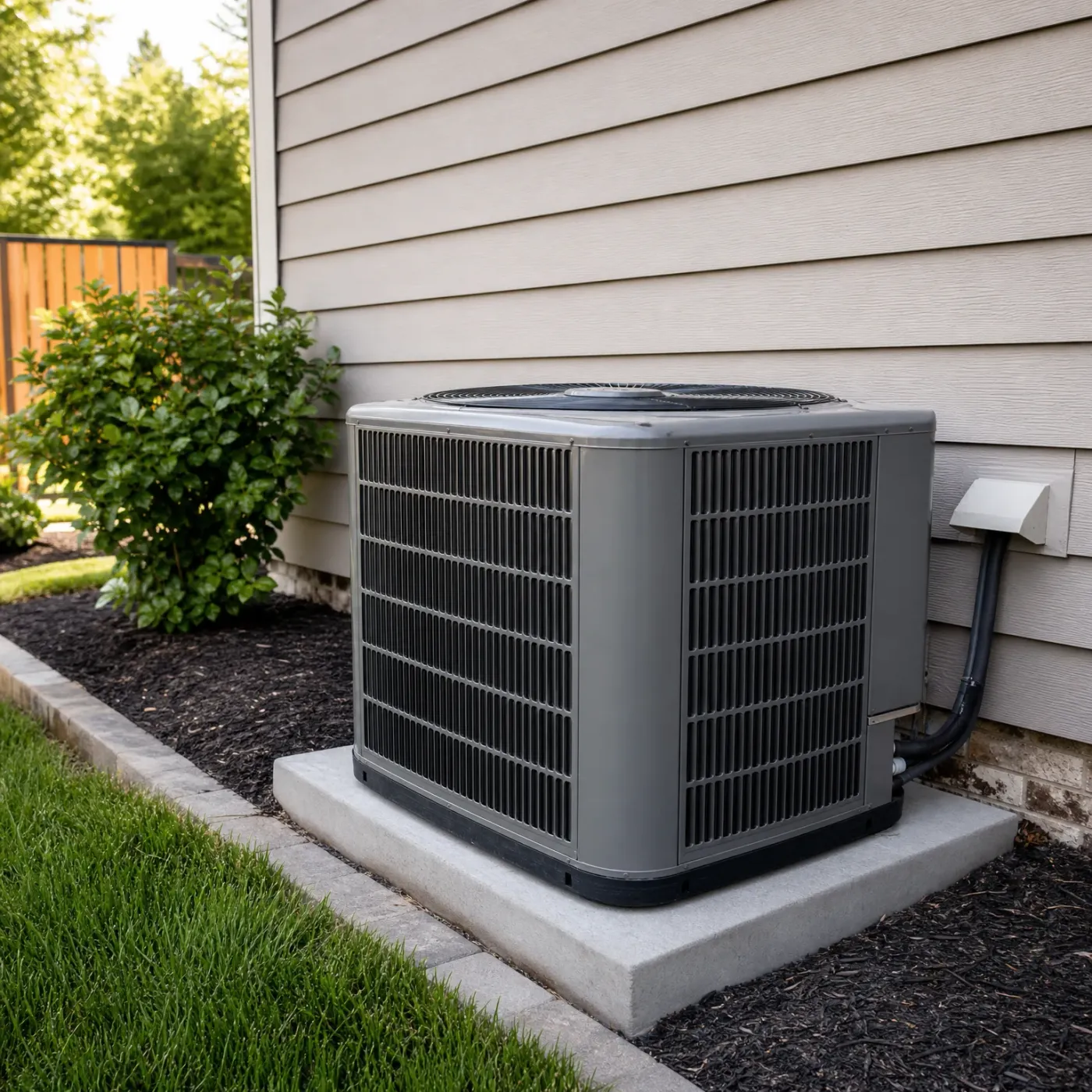
A gray outdoor air conditioning condenser unit on a concrete pad beside a house with horizontal lap siding, with a wall-mounted electrical disconnect box and refrigerant lines, shrubs, mulch and lawn around it.
The condenser hums on, draws in air through clean fins, and cycles the way it's supposed to.
An outdoor air conditioner condenser unit on a concrete pad beside a house wall with stucco lower section, horizontal siding above, and a white downspout to the right.
Dirt packed into the fins blocks airflow, and a unit running that dirty can trip the overload before the compressor ever kicks on.

What stops the compressor from starting

  • The thermostat sends a low voltage signal to a contactor, a small relay that closes to let power reach the compressor.
  • If the contactor's coil is dead or its contacts are pitted and burned, that signal never turns into power at the unit.
  • A run capacitor stores the extra push the compressor needs to start turning, and a weak one leaves the motor trying and failing to start.
  • The compressor itself has an internal overload switch that shuts it down if it's drawing too much current or running too hot.
  • Low refrigerant charge can trip that overload too, since the compressor works harder and runs hotter trying to move refrigerant that isn't there.
  • Some of these parts fail quietly over a few seasons, so the unit can go from working fine to not starting with no warning in between.

The thermostat itself doesn't power the compressor. It sends a low voltage signal down to the outdoor unit, where a contactor is waiting to close and let real power through. That contactor is a small relay with a coil and a set of contacts, and either half can fail on its own. The coil can die from age or a power spike. The contacts can pit and burn from years of arcing every time they close, until they stop making a clean connection even when the coil pulls them shut.

If the contactor does its job, the compressor still needs a push to get moving. That's what the run capacitor is for. It stores a charge and releases it at startup, giving the motor the jolt it needs to turn over. A capacitor that's weakened doesn't fail outright. It just stops giving the compressor enough to start, so the motor tries, strains, and stops.

The compressor also protects itself. It has an internal overload switch that cuts power if it's running too hot or drawing too much current, which is exactly what happens when refrigerant charge is low and the compressor is working harder to move less of it. None of these parts announce they're wearing out. A system can run fine right through a Colorado summer and then just stop one afternoon.

A man in a blue T-shirt sits on a light gray sofa, laughing while looking at an open laptop in the foreground, with a framed picture, lamp and potted plant behind him.
A bearded man in a blue and brown plaid flannel shirt stands indoors looking out a window at snow-covered trees, with a ceramic mug on the windowsill.
A gray outdoor air conditioning condenser unit on a concrete pad beside a house with horizontal vinyl siding, with mulch, a shrub, and lawn nearby.

One request and it's handed off

Describe what your air conditioner is doing once, in one form.

Get the air conditioner repair search off your mind today.

Hand it off

There's no charge for the request.

A closed silver laptop and a glazed ceramic mug on a wooden table, with a blurred kitchen counter, potted plant, cutting board and window in the background.

A quiet unit on a hot afternoon doesn't fix itself

While the outside unit sits dead, the house keeps gaining heat it can't get rid of. In a Colorado summer, with the sun on the house most of the afternoon, that adds up fast. The fan inside can run all day and never bring the temperature down, because the air coming out of the vents isn't actually cold. That's wasted power on top of a system that isn't cooling.

If you deal with small problems before they grow, you already know this isn't one to leave alone until it's a hundred degrees out and every repair shop in the area is booked solid. Finding a contractor on your own means calling around, describing the same symptoms to each one, and weighing quotes with no way to know who's actually right about the cause. Send the form here instead, and that search becomes someone else's job. A licensed contractor gets the details and takes it from there, and you get your afternoon back.

A living room corner with a beige sofa and cushion, a round wooden coffee table holding a pale ceramic vase of eucalyptus stems and a wooden bowl, and a curtained window with a potted plant above a latticed radiator cover in the background.
A single-story gray horizontal-siding house with multiple front-facing gables, white-trimmed windows, a dark front door, and a concrete walkway crossing a partly dry lawn under a clear blue sky.

Colorado air is dry. Summer dew points here average 42°F, according to NOAA climate data, which is low enough that sweat evaporates off your skin before you ever feel sticky. That dryness hides a problem when your compressor won't start. In a humid state, a dead compressor means a house that feels swampy within an hour, and you'd know something's wrong fast. Here, the air stays dry even as the house heats up, so the only sign is the temperature climbing on the thermostat. The dry air won't warn you. By the time the house feels hot to you, it's already well past the temperature you set, because dry heat is easier to ignore until it isn't.

NASA POWER T2MDEW county cells weighted by homes

An outdoor air conditioning condenser unit on a concrete pad beside a house with light vinyl siding, with electrical conduit running to a wall-mounted disconnect box and a shrub in mulch to the right.
Before you get your air conditioner repair
A gray outdoor air conditioning condenser unit on a composite pad beside a house with horizontal lap siding, with a wall-mounted disconnect box, refrigerant lines, and a wooden fence and shrubs to the left.
After you get your air conditioner repair

What a locked rotor sounds like

Sometimes the outside unit isn't silent at all. You get a single hum or a faint click every few seconds, then nothing. That's the compressor trying to start and failing, usually because the start capacitor can't give it the jolt it needs. A contractor can hear this over the phone sometimes, but checking it in person tells them whether the capacitor is weak or the compressor itself has seized.


What a dead contactor sounds like

If the unit outside is completely silent, no hum, no click, the problem is further back in the circuit. Power likely isn't reaching the compressor at all. That points to the contactor, the relay that closes when the thermostat calls for cooling. A stuck or burned contactor never sends power out, so the compressor never gets the chance to try starting in the first place.

Power costs 15.69 cents per kilowatt-hour statewide

At 15.69 cents per kilowatt-hour, a compressor that won't start can go two ways for your bill. Either it stays off and the indoor fan runs all day moving warm air, or it short cycles and strains to start over and over. Neither one cools the house, and both cost you for power that isn't buying comfort.

EIA-861 2025 statewide residential average

A compressor that won't start comes down to a handful of parts: the capacitor, the contactor, the fan motor, maybe a tripped overload from dirty fins. The outside unit stays quiet either way, and the house keeps the heat it can't get rid of. Finding which part failed means someone has to actually test the unit, not guess from the thermostat. That's the part you don't have to do yourself. Instead of searching through contractors, calling a few, explaining the same quiet compressor story to each one, then sitting on quotes trying to compare them, you send one form and the search is done. Someone qualified to test the capacitor and contactor takes it from there. You still have a repair ahead of you, but the work of finding who does it is off your plate. The unit's sitting there right now, not cooling anything, and that part of the problem doesn't need to stay yours to solve.

A dark wood cabinet with a paneled door and a ceramic pot of green foliage on top stands in a beige-walled room with white baseboard, a window at left, hardwood floor, and a patterned area rug.
A dark wood glass-front cabinet holding folded towels, woven baskets and a ceramic vase stands in a bathroom corner beside a window, with a potted fern and stacked towels on top and a freestanding tub partly visible at left.
A woven basket holding a green cushion and a cream fringed knit throw sits on a wood floor in a room corner beside a window and a dark wooden cabinet.
Corner of a room with a dark wood cabinet topped by a round vase, a linen curtain at a window, white baseboard, oak plank flooring with sunlight patches, and a woven jute rug in the foreground.
A dark wood sideboard against a pale wall holds a shallow stone bowl and a round ceramic vase with leafy branches, with sunlight from a curtained window falling across the wall, wood floor and woven rug.

Done looking for an air conditioner pro

Fill out one short form instead of calling around.

Hand off the search

You only hire the pro if you want to.


