








Colorado AC Install

AC tune-up before summer in Colorado Springs, CO

Send the form, and lining up the air conditioner tune-up stops being yours to chase.

Hand it over

Should I get my AC tuned up before summer in Colorado Springs?

You've seen the forecast turn warm and you're wondering if your AC needs attention before you actually need it. Maybe it ran fine last year, or maybe it struggled a little toward the end of summer and you want to avoid a repeat. Either way, the question is whether a tune-up now is worth doing, or whether you should just wait and see if the unit turns on when you need it.

Yes, get it done before the heat arrives

A tune-up checks the refrigerant charge, the electrical connections and the condenser coil while the unit isn't under load yet. A system that sat idle all winter can have a weak capacitor, a dirty coil or a low charge, and none of that shows up until the first hot stretch asks the unit to run for hours at a time. In Colorado Springs that stretch comes fast once summer sets in, and dry heat doesn't give a struggling system any breaks. Catching a problem in May means it gets fixed on a normal schedule. Catching it in July means it gets fixed after you've already spent a few days without cool air.

A gray outdoor air conditioner condenser unit on a concrete pad beside a house with horizontal siding, with an electrical disconnect box and conduit on the wall behind it.

Why the heat exposes weak parts

A capacitor or a contactor that's wearing out can still run the system on a cool morning. Put that same unit through an 85 degree afternoon and the strain shows. The compressor draws harder, the motor runs longer, and a part that was barely holding on gives out. A tune-up catches a weak capacitor or a connection that's loosened before July asks the system to run for hours without a break.

An outdoor air conditioner condenser unit on a concrete pad beside a house with horizontal lap siding, with a gray electrical disconnect box and conduit on the wall, grass in the foreground and a plain light wall at left.

What a dirty coil does to the bill

The outdoor coil gives up heat to the air outside, and it can only do that if air moves through it freely. A season of cottonwood seed and dust cuts that airflow down, so the system runs longer to move the same heat. It also runs the compressor harder, which is the part most likely to fail outright. Washing that coil out is routine work, but it's the difference between a unit that cools in twenty minutes and one that runs most of the afternoon.

Tune It Up or Take the Chance

Tune-up now

  • A contractor checks refrigerant charge while the unit is idle, so a low charge gets caught before a hot afternoon makes the compressor work through it.
  • Coils get cleaned before pollen and dust have baked onto them all spring, and a clean coil moves heat the way it was built to.
  • A weak capacitor or contactor gets found on a mild day, not during the first 90 degree stretch when you actually need the system to start.
  • Scheduling is open in spring, so you pick a day that works instead of waiting behind everyone else whose AC already quit.
  • If a part needs ordering, there's time for it to arrive before the house actually needs cooling.

Wait and see

  • The unit might run all summer without trouble, especially if it's newer or was serviced last year.
  • You avoid paying for a visit if nothing was actually wrong with the system.
  • A small problem, like a capacitor on its way out, often doesn't show itself until the compressor is under real load on a hot day.
  • If something does fail in July, you're calling during the week every other AC in El Paso County is failing too.
  • A system that runs with a bad part all summer puts more strain on the compressor than one that gets the part replaced in spring.
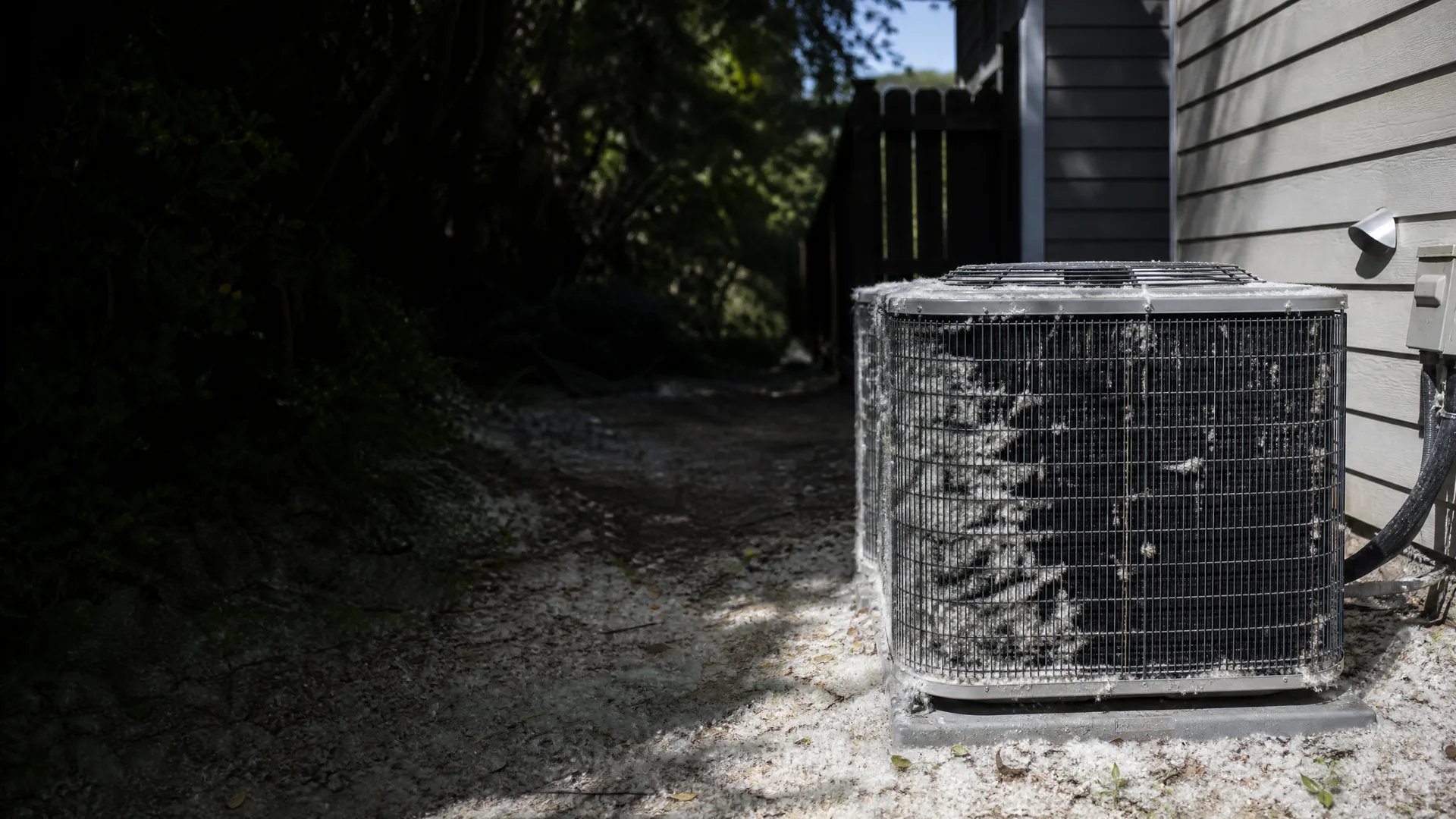
An outdoor air conditioner condenser unit covered in white foam-like debris sits on a concrete pad beside a light-colored lap-sided house, with white flecks scattered on the ground and dark trees and a wooden fence behind.

You're out pulling weeds along the side yard when you notice it. The cottonwoods let go early this year, and the drifts of white fluff have caught on everything, the fence line, the gate latch, the condenser fins. You crouch down and see the fins are packed solid with it, a felt-like layer across the whole coil. The unit's running, you can hear the fan, but the airflow coming off the top feels thin for how warm the afternoon has gotten. You brush at the fluff with your hand and more of it just sits there, pressed in tight. You straighten up, pull out your phone, and send off the request. It's out of your hands now.

Send one request and you're done looking

A tune-up now means someone is looking at your unit before it has to work for anything. That's a different inspection than one done in July, when the compressor is already straining and small problems hide behind the noise of a system running flat out. In May, a weak capacitor shows up as a weak capacitor, not as a no-cool call at 6pm on the hottest day of the year. Sending the request is the only part of this that's on you. After that, it goes to a contractor who works on AC systems around Colorado Springs all spring, someone who has seen what cottonwood fluff does to a condenser and what a winter of sitting idle does to a contactor. You're not left comparing quotes or explaining your situation more than once. You noticed the forecast, you're here, and the next step is one form away from being someone else's job instead of yours.

What a tune-up actually checks

  • A tune-up starts with static and total external pressure readings, which show if the blower is fighting ductwork it can't move air through.
  • The tech checks superheat and subcooling against the manufacturer's numbers, not just a pressure gauge glance, to confirm the charge is correct.
  • Electrical checks include capacitor microfarad readings against the rating stamped on the part, since a capacitor can test weak long before it fails outright.
  • The condenser coil gets rinsed from the inside out, because dirt pushed further into the fins from outside only makes airflow worse.
  • Contactor contacts get inspected for pitting, since a pitted contactor can stick closed and keep the compressor running after the thermostat is satisfied.
  • The tech checks amp draw on the compressor and fan motor against their rated amps, which catches a motor working harder than it should before it trips a breaker.

A real tune-up follows a sequence, and each step catches something the one before it would miss. It starts with airflow. The tech measures static pressure to see what the blower is working against, because a system can have a full charge and clean coils and still run hot if the duct system is choking it. From there it moves to the refrigerant side. Pressure alone doesn't tell you much with the unit running against spring temperatures, so the tech works out superheat and subcooling and checks those against the manufacturer's specification for that model, not a general rule of thumb. Electrical checks come next. A capacitor gets tested in microfarads against the number stamped on its case, since a capacitor can drift well below that rating and still start the compressor, right up until the day it doesn't. The contactor gets a close look too. Contacts that have pitted from normal arcing can stick, and a stuck contactor keeps the compressor running after the thermostat has already called for it to stop. The condenser coil gets rinsed from the inside, pushing debris back out the way it came in rather than deeper into the fins. Last comes amp draw on the compressor and fan motor, checked against their rated amps, which shows a motor straining before it ever gets bad enough to trip the breaker.

A man in a navy sweater reclines with closed eyes in a beige armchair in a living room, with a lamp, wooden cabinet, bookshelf, potted plant, and a side table holding a newspaper and mug nearby.
A man in a blue henley shirt reclines on a leather chair with his eyes closed, beside a window, a houseplant, a side table with a newspaper and a dark mug.
A man in a gray sweatshirt reclines with his eyes closed in a dark leather chair, with a bookshelf behind him and a side table holding folded newspapers, a mug, and a potted plant by a window.
A man in a blue sweater leans back on a brown leather chair with his eyes closed and a slight smile, in a room with bookshelves, framed pictures, a potted plant by a window, a folded newspaper and a dark mug on a table.
A gray outdoor air conditioner condenser unit on a concrete pad beside a house with dark horizontal siding and a stone base, surrounded by gravel, with a flowering shrub at left and a concrete walkway in front.

What a clean, maintained unit looks like

The condenser sits on its pad, fins clear, cabinet free of grime, disconnect box intact on the wall beside it. Air moves through the coil the way it was designed to. Nothing is blocking the fins or trapping heat against the casing, so the compressor pulls current it was built to handle.


An outdoor air conditioner condenser unit sits on a concrete pad beside a stucco wall, with refrigerant lines and conduit running to the wall and a shrub to the left.

What a neglected unit looks like

Fins are coated in grime and the casing has gone dull from years of weather. Refrigerant and electrical lines still run into the wall, still carrying current and charge, but a coil caked like this can't shed heat the way a clean one does. The compressor behind it works harder for the same result.

An outdoor air conditioner condenser unit sits on a gray pad beside a light vinyl-sided wall, on a concrete slab next to a gravel bed.
Before you get your air conditioner maintenance
A gray outdoor air conditioner condenser unit on a concrete pad beside a house with horizontal lap siding, with a wall-mounted disconnect box and conduit, mulch bed, shrub, and lawn nearby.
After you get your air conditioner maintenance
  1. Power to the unit is shut off at the disconnect first.

  2. Condenser fins get rinsed clean of pollen and cottonwood fluff.

  3. Refrigerant charge is checked against the manufacturer's superheat and subcooling numbers.

  4. Contactor, capacitor and electrical connections are tested under load.

Cooling runs July through August

Two months a year is all your AC owes you here, July and August. The other ten, it sits idle. A short run like that means a tune-up in spring often turns up what the unit couldn't show you the summer before.

NOAA nClimDiv 1991-2020

A gray-haired man in a blue quarter-zip sweater sits in an armchair with his eyes closed, beside a large window with bare trees outside and a potted plant and lamp nearby.
A woman in a cream knit sweater sits in an armchair with her eyes closed and head tilted back, beside a window showing orange autumn foliage and a wooden side table with a mug.
A single-story house with light gray horizontal siding, dark gray shingled gables, black shutters and a dark front door, fronted by a mulched bed of small shrubs and a large lawn under a clear blue sky.

The weather service puts the summer dew point across El Paso County at an average of 41°F for June, July and August. That's dry air. It's part of why Colorado Springs summers feel manageable even when the afternoon runs hot, and it's also why people notice right away when their AC stops keeping up. Dry air gives a unit less to fight, so a system that's slipping doesn't hide behind humidity the way it might elsewhere. If the house feels warmer than the thermostat says, or the air blowing out doesn't feel as cold as it used to, that's usually a real sign something needs a look, not just the weather playing tricks on you.

NASA POWER T2MDEW

A tune-up before the heat arrives catches the weak capacitor, the dirty coil, the low charge, while it's still cheap to fix and easy to find. That's the whole answer. Get it looked at in spring, before July and August ask more of the unit than a worn part can give. The contractor who handles this is local, someone who services AC units around Colorado Springs all season and knows which parts give out first in this climate, the ones cottonwood fluff clogs and the ones a dry heat strains. You'll hear from one contractor, not a handful of companies competing for the job, so there's no pile of calls to sort through. Send the request and the unit gets checked before the heat finds whatever's already wearing thin.

A modern two-story house with dark siding and stone base at dusk, with lit soffit lights, a path of large rectangular pavers set in dark gravel, planting beds, a lawn, and an orange and blue sunset sky above distant trees and water.

Air Conditioner Maintenance

Finding a pro stops being your job

Step 1 of 3: Equipment
  • A brown leather and wood armchair with a cream knit throw sits in a corner beside a woven basket holding a dark cushion, under a framed mountain photograph, with a wood-trimmed window showing yellow and green foliage.
    • Get matched with a pro who works on air conditioners in El Paso County.
    • Your air conditioner tune-up request goes to a pro who covers El Paso County.
  • A dark wood dresser against a pale wall holds a ceramic vase of eucalyptus branches, a stack of books with a wooden bowl, and a woven basket, with a framed landscape painting above and a woven basket holding a knit blanket on the floor beside a window.
    • Send it once and finding someone is no longer on you.
    • Once you send the form, finding a pro is off your list.
  • A window seat with beige linen and brown textured cushions, a chunky knit blanket, and an open book, beside a window showing blurred yellow autumn foliage.
    • Fill out one form instead of calling around for an air conditioner tune-up.
    • One form replaces the calls you'd make to find an air conditioner pro.
  • A cream upholstered armchair with a rust-colored pillow and knit fringed throw sits beside a window with a ceramic vase of orange-leafed branches on the sill, overlooking autumn trees and leaf-covered ground.
    • A licensed local pro takes the request for your air conditioner tune-up.
    • Your request stays with one local pro.